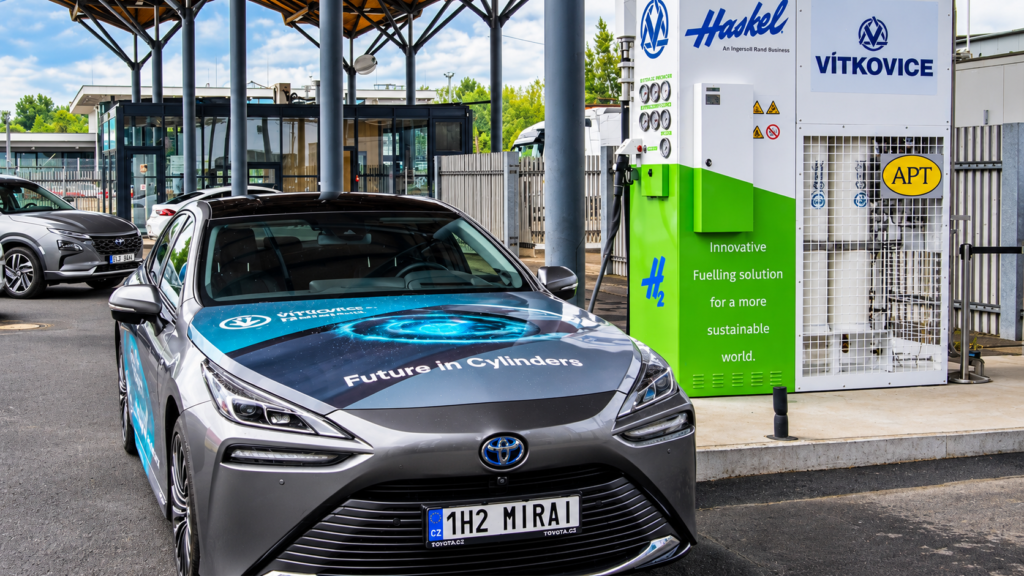
A refueling station built for a fraction of the cost of subsidized projects, cascade filling without a precooler, and a new station in the Zlín Region. In a recent interview with POSITIV Business & Style magazine, Jan Světlík and Vladimír Dynda discuss the results of the Ostrava pilot station after four years of operation, the bottlenecks facing hydrogen mobility, and why refueling stations alone are not enough.
In 2022, you built a refueling station in Ostrava that is presented as a significant starting point for hydrogen mobility in the Czech Republic. What has it demonstrated after four years?
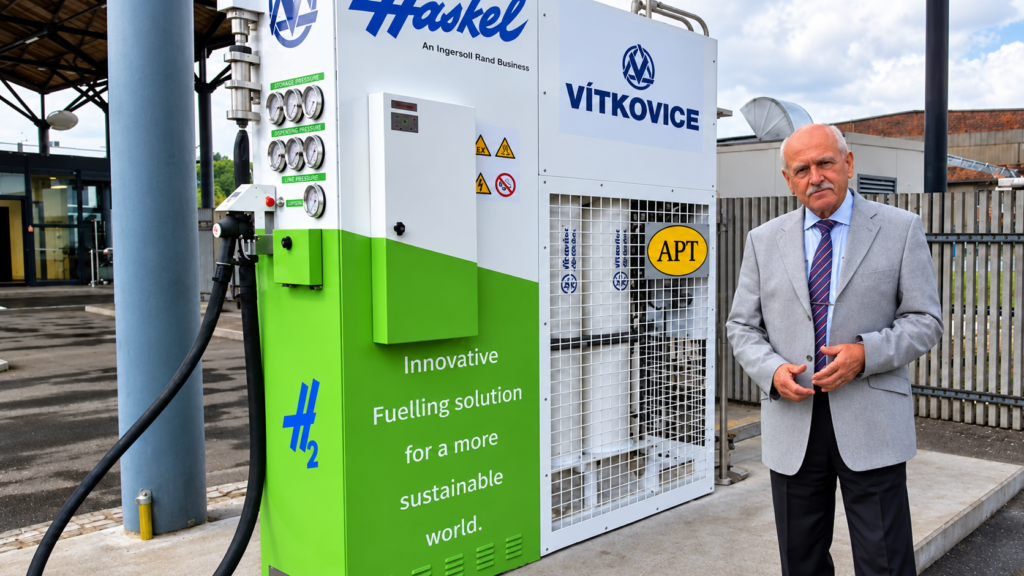
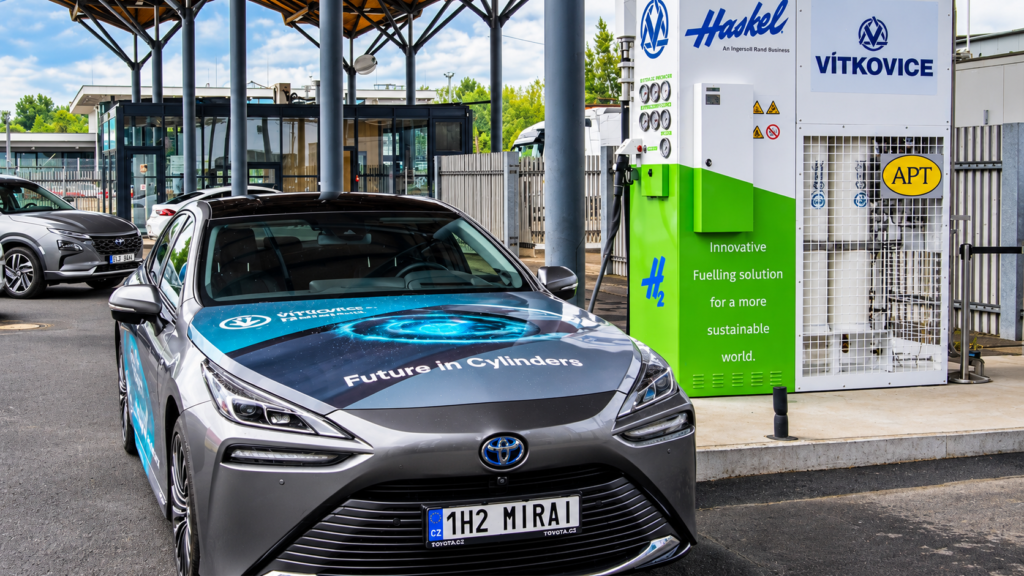
Vladimír Dynda: The station fulfilled its purpose by demonstrating that it is possible to build a relatively simple facility without state support—that is, quickly and without unnecessary overhead costs. As a pilot project, the station facilitated the training of the participating designers, contractors, and the operator, thereby clearly fostering expertise in the field.
Jan Světlík: The station has absolutely served its purpose, as it gave us experience with a novel method of hydrogen refueling. We invested in the station and developed it in partnership with APT. We didn’t want to spend a fortune; it cost just a fraction of what subsidized stations cost. At the same time, we developed a revolutionary cascade refueling method to avoid using the standard cooling unit, which drives up the cost of the entire station. Thanks to this, we have a proven technology that has moved us forward tremendously.
From your perspective, how is hydrogen mobility developing?
Jakub Světlík: For me, the development of hydrogen mobility has been an absolute disappointment because functional solutions are being ignored. For stations built using subsidy programs, project commissioners demand the most expensive technologies, which ultimately undermines the entire mobility sector. For instance, the city of Ostrava awarded a contract for a refueling station costing 200 million crowns, even though it should have cost around 50 million. It all comes down to the investor setting the right specifications.
“For me, the development of hydrogen mobility is an absolute disappointment, because things that work are not being used.”
It is often said that without refueling stations, there will be no hydrogen vehicles, and without vehicles, building stations is not economically viable. In your opinion, who needs to take the first, economically risky step?
Vladimír Dynda: I am convinced that the first step must be to ensure a suitable infrastructure of refueling stations. The parties responsible for taking this step or rather, for creating the conditions to make it happen are the ministries representing state policy on environmental protection and related aspects, such as increasing the share of domestic energy sources (specifically, renewable energy). These are the Ministry of Transport, the Ministry of Industry and Trade, and the Ministry of the Environment. Thanks to them, several pilot projects have already been implemented. Systematic efforts in this area will eventually evolve into a matter of broad public interest. After all, two of the four public refueling stations were established through private initiative without state support, while the other two were built with such support. I should also add that there are two other stations in the country located at public research institutions (v.v.i.).
APT offers stations of various sizes and capacities. At what level of hydrogen output or number of regular vehicles does a refueling station become economically viable?
Vladimír Dynda: That is quite a difficult question, though I understand why it is being asked. The economy as the fifth dimension of our existence drives the world. A question framed this way elicits multifaceted answers. When we consider that hydrogen is produced (since it does not exist in sufficient quantities in nature, we essentially have to manufacture it as a form of energy) from electricity or from oil and gas industry products, it cannot possibly be cheaper than the inputs required to produce it. These costs vary over time and also depend on the station’s geographic location. The origin of the hydrogen also plays a major role.
We looked into hydrogen for transport specifically, hydrogen generated as a technological byproduct of salt electrolysis. The process is powered by the Temelín nuclear power plant, meaning it uses clean, low-emission electricity. For the producer, this hydrogen serves as an energy carrier, and they offered it to a planned fleet of municipal hydrogen buses without adding any extra commercial markups essentially at an exceptionally low price compared to all other hydrogen sources (one-third to one-quarter of the cost). Ultimately, however, no agreement was reached because, under current assessment standards, hydrogen produced this way despite meeting production-related emission criteria cannot be used to meet transport decarbonization targets! Consequently, the fleet operator lost interest in this hydrogen, as it would not help avoid the penalties associated with the RED III directive. Several different aspects are at play here. To give you an idea of what we consider a viable economic model for a hydrogen refueling station: it always comes down to aligning the station’s operational parameters with its intended purpose. It makes no sense to build a station with a capacity of 1,000 kilograms of hydrogen per day if only one vehicle shows up a week. We should avoid burdening the station with requirements that, while technically feasible, are prohibitively expensive in terms of both investment and operation. A prime example is the requirement for rapid refueling to save just a few minutes per fill-up; this necessitates the installation of hydrogen cooling systems with power demands running into the tens of kilowatts. It is, therefore, a requirement that resolves nothing in terms of station operations but entails increased investment and operating costs.
An equally burdensome factor is the excessive demand regarding the number of vehicles to be refueled in rapid succession. Typically, a station’s capacity should accommodate about three consecutive vehicles. German statistics show that the average interval between vehicle arrivals for hydrogen refueling is approximately 18 hours. The situation differs for fleets, where the refueling of individual vehicles can be scheduled; indeed, fleet servicing is a factor that improves the economic viability of hydrogen refueling station operations. Another favorable aspect for the economic viability of these stations is on-site hydrogen production at the point of immediate consumption. An autonomous, self-contained solution eliminates the need for hydrogen transport, thereby removing one cost component.
In our 2023 interview, you mentioned that while there was a lot of talk about hydrogen in the Czech Republic, there were few actual projects or companies making a living from it. What has changed at Cylinders Holding since then? How many hydrogen solutions have you delivered in the meantime, and to which countries?
Jan Světlík: Our hydrogen projects are growing worldwide. We supply markets across the globe—Europe, the Americas, and Australia—and we also deliver a significant amount to South Korea. In the Czech Republic, we are likely the only company exporting hydrogen technologies with a substantial annual volume of around 10 million euros. We supply a wide range of products; for instance, we have mastered standard hydrogen storage solutions for pressures of 100, 200, 300, 420, 555, 1,000, and even 1,100 bar.
You also speak of a model that utilizes not only the hydrogen itself but also the oxygen and heat generated in the process. How exactly would such a system operate, and for what type of industrial facility might it make economic sense?
Jan Světlík: Producing hydrogen via electrolysis yields additional products: oxygen and a large amount of heat. At the same time, you gain grid flexibility. If you produce multiple products but sell only one, you face an economic challenge. We need to shift our mindset and utilize all these highly marketable commodities. Then, we can supply hydrogen and the other products at a very attractive price.
Production makes sense when electricity prices are negative when you get paid to consume it. Conversely, I wouldn’t produce hydrogen when the price of electricity is at its peak.
In your view, can stable electricity from nuclear power or future small modular reactors provide a more cost-effective basis for low-emission hydrogen production than renewable sources alone?
Jan Světlík: Integrating a small nuclear reactor with electrolyzers creates tremendous potential for the efficient production of electricity, hydrogen, oxygen, and heat. Moreover, the nuclear reactor supplies superheated steam, which benefits certain hydrogen technologies. Hydrogen offers an ideal way to store electricity during periods of low demand. I see the future of energy in nuclear power, with hydrogen production serving as an integral part of it.
“I see the future of energy in nuclear power; hydrogen production will be an integral part of it.”
Cylinders Holding offers SMART containers and smart solutions for hydrogen transport, with logistics that can be managed from a central location or a mobile device. What exactly makes this solution “smart,” how does it differ from a standard shipping container, and where is it already in use?
Jan Světlík: The SMART container features internal controls, remote operation capabilities, an autonomous system, and a computer center. If we ship a container holding 5,500 m³ of gas and a client requests 1,000 m³, we can program the container remotely to release exactly that amount and nothing more without anyone having to go there in person to take measurements.
Usage is currently very limited, but I consider it the container of the future its time is yet to come.
What does such a smart solution mean from the perspective of the operator and the system designer? What information must the system monitor and manage to deliver genuine savings, safety, and more efficient supply for the filling station?
Vladimír Dynda: We need mutually compatible signals to control the emptying of the SMART container so that the supply unit functions as an integral part of the entire installation. This optimizes container utilization while simultaneously incorporating the container into the safety protocols of the supplied technology. A sufficient number of such containers must be in operation for the container itself to serve as a hydrogen source for the stations, rather than merely acting as a means of transport.
If properly designed, is a hydrogen station riskier than a conventional filling station or a natural gas facility?
Vladimír Dynda: All stations feature the same safety pictograms regarding operational safety. From this, one can infer that there are no fundamental differences in the safety concepts of the various types of filling stations. All the fuels used are highly concentrated sources of energy, and this is something to keep in mind not to induce fear, but to ensure vigilance throughout every stage of a station’s lifecycle: design, manufacturing, installation, and operation. Historical safety data is positive. Provided we adhere to the principle that system safety is not a static state but a process managed by qualified personnel, I see no differences.
Mr. Světlík, you have long criticized the over-regulation of European industry. Mr. Dynda, conversely, you helped draft the rules designed to ensure the safety of hydrogen facilities. Where, in your view, does the line lie between necessary safety measures and regulation that merely drives up costs or stalls projects?
Jan Světlík: The European Commission killed the entire hydrogen mobility sector with its strict conditions for instance, by requiring green hydrogen from sources that haven’t even been built yet, thereby deterring over 90% of investors. We need to put hydrogen technologies into operation first; only then can we discuss the “greenness” coefficients used to evaluate them.
I often liken European Commission regulation to regulating an unborn child and dictating which primary and secondary schools they must attend. During the initial implementation phase, it is not necessary to strictly mandate green hydrogen.
Vladimír Dynda: I am not personally certain that I see a specific threshold causing the effect you are asking about. It is a positive thing that we work with harmonized technical standards and legal regulations; some of these are even shared with the USA. My point is that a vast number of professionals adhere to these regulations, and if any negative administrative impacts were to arise, someone would certainly speak up. That applies to safety. The situation is different regarding the regulation of production and consumption, where “hydrogen racism” by which I mean the categorization of hydrogen based on color and production method can delay the deployment of hydrogen technology. In this regard, I am convinced that we are at a stage of hydrogen application development where the results of the applications matter more than the specific source of the hydrogen currently being used. Moreover, hydrogen from renewable sources is scarce and comes at prices that completely shatter existing economic calculations. Consequently, new hydrogen technology would remain a niche solution rather than seeing mass adoption. But that is not the current objective! We have clearly defined targets set out in the Czech government’s resolution on updating hydrogen technology development such as the target number of hydrogen vehicles and refueling stations, and a total hydrogen consumption of 20,000 tonnes per year by 2030. Therefore, what we need is support for deploying these technologies, not a stifling of progress through restrictions based on the “color” or origin of the hydrogen.
Mr. Dynda, in the past, you pointed out that hydrogen projects can complicate public tenders based primarily on the lowest price, long-term warranties, and high bank guarantees factors that disadvantage smaller technology companies. In your view, have conditions changed since then?
Vladimír Dynda: In principle, the Public Procurement Act makes no distinction between a tender for the supply of, say, hygiene products from a warehouse shelf and a unique high-tech solution involving hydrogen at 1,000-bar pressure. Such cutting-edge technological systems are typically offered by smaller, agile companies. Yet, factors such as bank guarantee requirements, long warranty periods, retention money, payment terms, and the complex legal processes mandated by Act No. 134/2016 Coll. which require the involvement of legal specialists stifle small businesses. Imagine a project worth, for instance, CZK 100 million paid only after the signing of the final handover protocol and subject to a 10% retention held throughout a 60-month warranty period being undertaken by a small enterprise. This is a challenge even for large corporations, let alone small businesses. The answer to your question is that nothing has changed; the law remains unaltered, and there are no plans to change it. While the legislation works well for many types of tenders, it is ill-suited for the development of entirely new, cutting-edge technologies that carry a high risk of encountering specific technical issues. Investors protect themselves with stringent contractual terms, often resulting in a situation where no one submits a bid for the tender. This causes delays relative to the original objectives of the adopted strategy for hydrogen technology development.
APT is preparing another filling station, including one in the Zlín Region. What can you publicly confirm about it at this stage?
Vladimír Dynda: Yes, that is correct. It is a public, off-grid hydrogen station capable of refueling at both 350 and 700 bar, where the hydrogen is produced on-site using an electrolyzer. The project investor is Solar Global Service, a.s. This group operates in the energy sector and has access to sufficient renewable electricity sources. Consequently, this will be the first station to supply exclusively renewable or “green”—hydrogen. Mr. V. Skopal, who heads the group, is a strong supporter of hydrogen technologies. One outcome of this initiative is the plan to use this new station to refuel ten public transit buses serving the Zlín Region. We have also expanded the system’s capabilities to include filling high-pressure cylinders with this green hydrogen (at 5.0 purity) for other parties interested in renewable hydrogen. Commissioning is scheduled for late October or early November. All equipment has now been delivered to the site, and final assembly is underway; in October, we will carry out the necessary safety and functionality verification procedures prior to the station’s launch. Please keep your fingers crossed for us; it is a complex and demanding undertaking, involving numerous external authorities to verify the results of the APT delivery.
“The filling station will thus be the first to use exclusively renewable or, if you prefer, green hydrogen.”
What experiences from Ostrava will already be taken into account in this project?
Vladimír Dynda: This is where the brilliance of Comenius’s approach advocating the principle of moving “from the simple to the complex” becomes evident. We follow in his footsteps and apply the same philosophy. We are now capitalizing on everything we learned years ago during our past deliveries and installations. It involves not only designing the solution but also selecting the right components and construction methods. It is also about productive collaboration with our subcontractors such as Vítkovice Cylinders, Tatsuno Europe, Maximator, and others all of whom gained valuable experience alongside us during earlier pilot projects. As you can see, this truly involves cross-border cooperation that yields positive results and fosters mutual reliability.
What is currently missing to ensure that the Moravian-Silesian Region sees not just isolated hydrogen projects, but an interconnected chain spanning production, storage, and distribution that links up with a stable end-user?
Vladimír Dynda: Goodwill in coordinating the region’s overall strategy free from vested interests and backed by all available resources. The experience gained in this way could lead to the formation of new organizational entities with specialized missions, such as in hydrogen distribution or specialized quality control and safety services specifically, partnerships linking hydrogen producers with refueling station operators and transport fleet operators.
Jan Světlík: Hydrogen projects are growing worldwide, and I hope the Moravian-Silesian Region will develop a robust hydrogen strategy that is actually implemented. If public hydrogen transport is introduced, the approach should start with local projects that are gradually interconnected and expanded. However, the situation in the Czech Republic is further complicated by the lack of a suitable source of clean hydrogen.
Your song “How About Some Hydrogen” is also well-known within the hydrogen community. Does the Czech hydrogen sector need more optimism today?
Vladimír Dynda: It seems people really like the song, and that inspired me to work on new lyrics. Hopefully, we’ll soon have the chance to share it with the public. Everything goes better with a smile and perhaps even better with a nice melody. Hydrogen needs attention; it represents one of the decarbonization options and efforts of a civilized society. I would like hydrogen to be a source of optimism for us, not a drain on it!
Photo: Karel Juchelka, Vladimír Dynda
The interview is part of a special print edition of POSITIV Hydrogen magazine.
Media Contact:
APT, spol. s r.o.
Web: www.apt.cz
Email: info@apt.cz